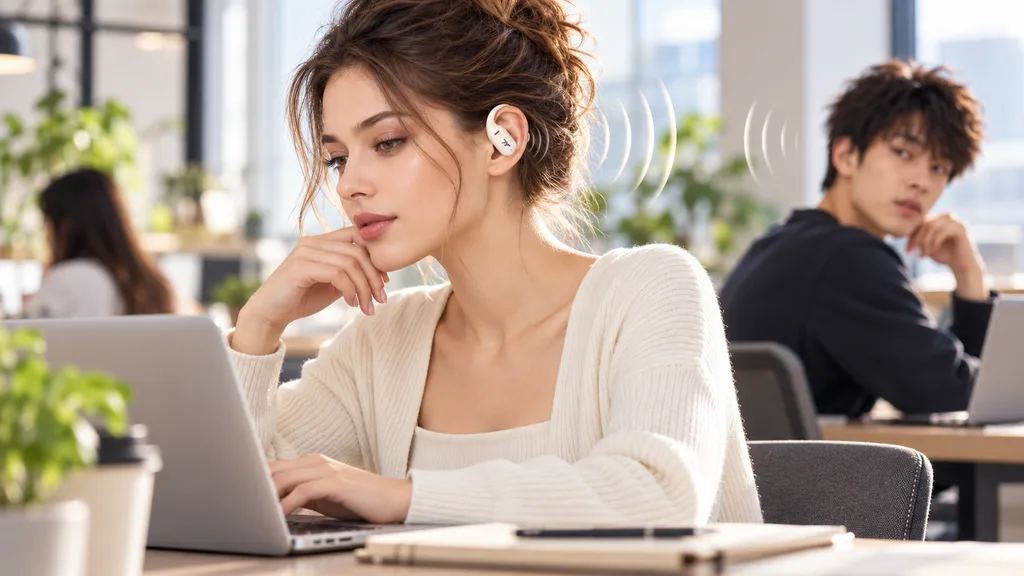
Can other people hear open ear headphones? Sometimes—but the answer depends far more on volume, distance, room noise, fit and the specific acoustic design than on the words “open ear” alone.
In a quiet office, library or bedroom, a person sitting close to you may hear a faint rhythm, voice or high-frequency detail if you listen loudly. At a moderate level in a normal street, gym or café, the same leakage may be difficult to notice. Open-ear headphones are designed to keep the ear canal open, so they trade some acoustic containment for awareness and comfort.
Editorial disclosure and evidence standard
TY sells open-ear audio products, so this is commercial educational content rather than an independent laboratory report. We do not present a universal “zero leakage” promise, a precise leakage percentage or a model-by-model decibel ranking unless a repeatable test method and product-specific measurements are available.
This guide distinguishes general design principles from measurements of a specific product and links to WHO safe-listening guidance below. Model-specific TY claims remain subject to product verification and real-use testing.
What sound leakage actually means
Sound leakage is audio energy that reaches people around you instead of only reaching your ears. It does not necessarily mean that another person hears your music clearly. Leakage may be a faint beat, a thin vocal line, a buzzing vibration, or a muffled version of a podcast.
Privacy and leakage are related but not identical. A coworker might notice that audio is playing without understanding the words. Research on room speech privacy distinguishes audibility from intelligibility and shows that background sound and room acoustics affect speech understanding. It does not establish a private listening distance for headphones.
Why open-ear headphones can leak sound
Open-ear headphones leave the ear canal unsealed. That is the feature that helps you remain aware of traffic, coworkers and other environmental sounds—but it also means the sound system does not have the same acoustic enclosure as a sealed in-ear earbud or closed-back earcup.
Open-ear air-conduction designs
Air-conduction open-ear headphones place small speakers near the ear. Acoustic design can change outward radiation: NTT’s PSZ Wearable research uses an enclosure to control opposite-phase sound waves. This is a specific design example; it does not establish TY performance or guarantee that nearby listeners cannot hear playback.
Bone-conduction designs
Bone-conduction headphones use contact transducers near the head. These transducers can also radiate airborne sound, as measured in a modified Aeropex setup in a 2023 study. That experiment did not establish what a nearby person could hear from an unmodified consumer headset. Check the exact model at the listening level you intend to use.
What can another person actually hear?
Check both audibility and intelligibility. Can the other person notice sound, identify the track, or understand words? Record the listening level and their position rather than assuming a particular sound character or a distance at which playback becomes private.
There is no universal distance at which open-ear audio becomes inaudible. Check the exact headset at the distances relevant to your shared space.
| Situation | What to check | Practical guidance |
|---|---|---|
| Quiet library or study room | Whether someone nearby can hear your audio | Keep the level low; pause if it disturbs others. |
| Open-plan office | Whether words are intelligible from the next seat | Ask a consenting coworker to check using non-confidential audio. |
| Home beside another person | Whether the person beside you can identify words or music | Lower the volume or pause if the audio disturbs them. |
| Gym or busy café | Whether leakage becomes noticeable as background sound changes | Do not raise the volume excessively to compete with noise. |
| Walking or outdoor exercise | Whether people near you can hear the playback | Keep the level low and do not assume that an outdoor setting provides privacy. |
| Public transport | Whether adjacent passengers can hear the playback | Assess noise isolation and outward leakage separately; an ANC label does not establish privacy. |
The six factors that control sound leakage
1. Volume level
Playback volume is one setting you can adjust directly. Try lowering it and repeat the informal check in the same setting. Record whether the nearby listener can still notice sound or understand words.
2. Distance from other people
A colleague sharing the same desk is in a different situation from a stranger several feet away. Distance can change audibility, but there is no universal distance at which leaked audio becomes private.
3. The surrounding environment
Libraries, bedrooms and quiet offices reveal small noises. Streets, gyms and cafés contain background sound that can mask leakage. The trap is that noisy environments may encourage you to raise the volume, increasing both leakage and listening exposure.
4. Driver direction and acoustic design
Driver position and enclosure design should be evaluated on the specific headset. Follow its wearing instructions and check outward audibility in that position. A directional-audio label alone does not establish a privacy rating.
5. Fit and position
Follow the model’s wearing instructions before checking leakage. Record the position and repeat the check after refitting. This guide’s informal check is intended for headphones worn as directed, rather than placed on a table.
6. The type of audio
Use both spoken audio and music when checking your own setting. Note whether the other person merely notices playback or can identify words or music. Do not assume that one type of audio will always be easier to hear or that bass-heavy audio requires a higher listening level.
Can Other People Hear Open Ear Headphones at Work?
They can be suitable for ordinary office listening when the volume is moderate and people are not sitting extremely close. However, they are not the safest choice for confidential calls, private financial information, legal discussions or any content that must not be overheard.
For a shared office, use a simple rule: if a colleague at the next seat can identify words from your call or podcast, lower the volume or move to a private location. A headset does not hide your own spoken voice from people in the room.
Open-ear vs sealed headphones: which contains sound better?
| Headphone type | Leakage considerations | Environmental sound | What to check |
|---|---|---|---|
| Open-ear air conduction | Varies with the model, fit and level | Can reach the unsealed ear canal | Check playback audibility from a nearby position. |
| Bone conduction | Airborne sound can also be radiated | Can reach the unsealed ear canal | Check the exact headset in its intended worn position. |
| Sealed in-ear earbuds | Depends on the model, seal, fit and level | May be attenuated; transparency modes vary | Check outward leakage separately from noise isolation. |
| Closed-back over-ear headphones | Can still leak, depending on the model, fit and level | Isolation depends on the model and mode | Do not rely on the closed-back label alone for confidentiality. |
Noise isolation concerns outside sound reaching your ears; leakage concerns your audio reaching others. Content privacy also depends on whether words can be understood, including your own speech during calls. Assess these separately: a seal or ANC feature does not guarantee confidentiality.
An informal leakage check
You do not need laboratory equipment for an informal household check. It can help you assess whether playback is audible to someone nearby, but it is not a calibrated measurement, laboratory test or privacy certification.
- Use your normal fit. Wear the headphones as intended. Do not place them on a table.
- Choose three audio samples. Use spoken voice, ordinary music and a bass-heavy track.
- Start at a low, comfortable level. Do not raise it to maximum for this check.
- Ask another person to listen from three positions. Test beside you, about one arm’s length away and across a small room.
- Repeat in a quiet room. A silent room reveals leakage that a café or gym may hide.
- Record what is identifiable. Can they only hear a faint sound, or can they understand lyrics and spoken words?
- Lower the volume and repeat the check. Note whether the nearby listener can still identify words or music.
How to reduce open-ear headphone sound leakage
- Try a lower playback level. Repeat the informal check at that level.
- Check the fit for your model. Follow its wearing instructions; air-conduction and bone-conduction devices may require different positioning.
- Use device volume limits or sound-exposure monitoring. These features can reduce the urge to listen louder than necessary.
- Avoid fighting environmental noise with volume. In very noisy transport or offices, use a more isolating design when appropriate.
- Use a private location for confidential material. A sealed headset alone does not guarantee that playback or your own speech cannot be overheard.
- Test the exact model. Leakage can differ substantially between products that share the same category label.
Volume, sound exposure and safer listening
Lowering playback volume can reduce your sound exposure, but leakage itself is not a measure of hearing safety. Hearing risk depends on listening level, duration and repeated exposure. Keep playback low, take breaks, and use compatible exposure warnings where available. A volume percentage or an unverified sound-level reading is not a guarantee of safe listening.
For broader safe-listening guidance, see the World Health Organization’s safe-listening guidance.
Open-ear headphones are not automatically safe at any volume. Their awareness benefit can be useful, but hearing risk still depends on how loudly and how long you listen. Take breaks and avoid raising the volume simply because the ear canal remains open.
What TY can responsibly say about sound leakage
TY can explain the design category, fit, intended use and general leakage factors. We should not promise “zero leakage” or assign a universal privacy score without model-specific testing. For any TY product, the responsible approach is to verify the exact model at realistic volume levels and publish the method if measured leakage data is later added.
If you are deciding between bone conduction and open-ear air conduction, read our comparison guide: Bone Conduction Headphones vs Open Ear Headphones. To browse TY’s current open-ear designs, visit the TY OWS Open-Ear collection.
Frequently asked questions
Can people hear open-ear headphones in a quiet room?
They may, especially if they are close and the volume is moderate to high. A faint rhythm or voice can become noticeable in a silent room even when it would be masked outdoors.
Do open-ear headphones leak more sound than regular earbuds?
Compare the specific models rather than relying on an open-ear or sealed label. A leakage comparison needs stated fit, listening level and measurement conditions; those labels alone do not establish the size of the difference.
Are open-ear headphones suitable for confidential calls?
Do not rely on an open-ear or sealed label for confidentiality. Use a private location when the content must not be overheard.
Do bone-conduction headphones leak sound?
Bone-conduction transducers can radiate airborne sound. This does not tell you how audible a particular headset will be to someone nearby. Check the model worn as intended in the setting where you plan to use it.
Can sound leakage be completely eliminated?
Engineering can reduce leakage, but neither an open-ear nor a sealed design guarantees complete privacy in every setting.
Does low volume prevent other people from hearing?
Lower volume can reduce leakage, but it does not guarantee inaudibility. An informal check can help assess your actual setting.
Are open-ear headphones safer for hearing?
Not automatically. Hearing risk depends on sound level, duration and repeated exposure. Keep the volume moderate, use sound-exposure monitoring when available and take breaks.