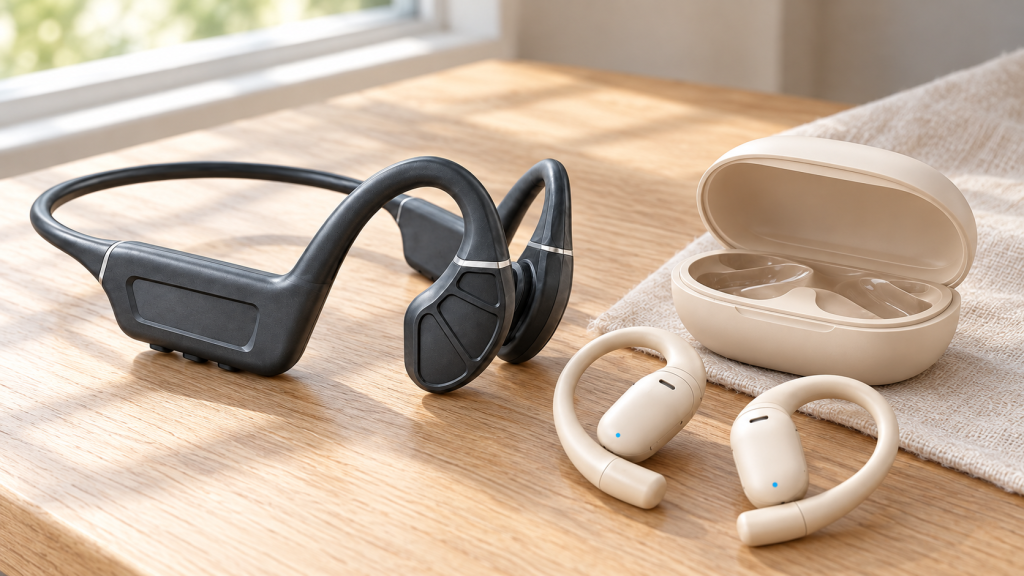
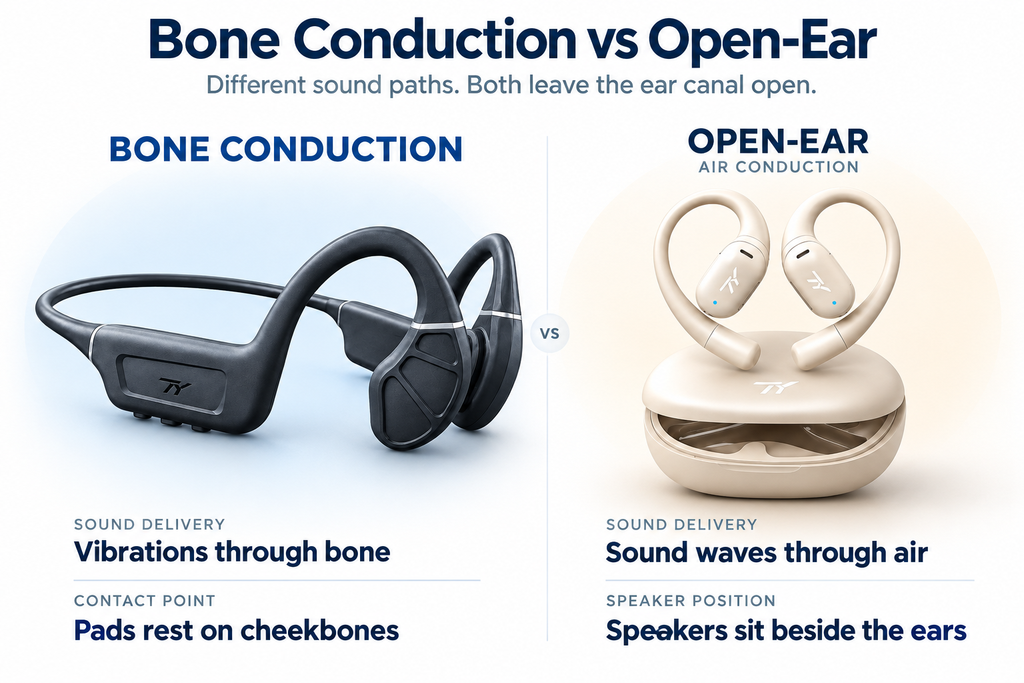
Bone conduction headphones vs open ear headphones can look like a simple either-or choice. In reality, the terminology is a little more nuanced: bone conduction is one way to create an open-ear listening experience, while many products sold as “open-ear headphones” use small air-conduction speakers positioned close to the ear without sealing the ear canal.
Both approaches leave your ears more open to the world around you. The main difference is how they deliver sound—and that difference affects sound character, fit, comfort and where each style tends to work best.
First, one important clarification
“Open-ear” describes the wearing style, not one single sound technology. The ear canal stays open rather than being sealed by an in-ear tip or covered by a traditional earcup. Bone-conduction headphones are therefore a type of open-ear headphone. However, in everyday shopping language, “open-ear headphones” often refers to air-conduction designs that sit near the ear and play sound through the air.
In this guide, we compare:
- Bone-conduction headphones, which use vibrating transducers resting against the cheekbone or temple area.
- Open-ear air-conduction headphones, which use small speakers positioned close to the ear canal without entering it.
How bone-conduction headphones work
Bone-conduction headphones convert audio into vibrations that travel through the bones of the skull toward the inner ear. The transducers usually rest in front of the ears, while a band or flexible frame holds them in place. Because the ear canal remains open, you can still hear much of the surrounding environment.
What this often feels like in practice:
- A secure, connected fit—especially with wraparound sport designs.
- Light pressure or vibration at the contact points, which some people notice more at higher volume.
- Clear spoken audio and useful awareness, with a sound signature that may feel lighter in deep bass than conventional air-conduction designs.
How open-ear air-conduction headphones work
Open-ear air-conduction headphones use compact speakers that direct sound toward the ear canal while staying outside it. Depending on the design, they may use independent ear hooks, clips or a lightweight band. The listening path is closer to the way everyday sound normally reaches your ears, but without an in-ear seal.
What this often feels like in practice:
- A more familiar audio presentation, often with a fuller sense of music than bone conduction.
- No ear tip inside the canal, which can be more comfortable for people who dislike in-ear pressure.
- A lightweight, everyday form that can work well for work, leisure, walking and light exercise.
Bone Conduction Headphones vs Open Ear Headphones at a Glance
| Feature | Bone conduction | Open-ear air conduction |
|---|---|---|
| Sound delivery | Vibrations through contact points near the cheekbones | Speakers direct sound through the air toward the ears |
| Ear canal | Open | Open |
| Typical fit | Wraparound band or connected sport frame | Independent ear hooks, clips or open band designs |
| Sound character | Clear and practical; bass may feel lighter | More familiar and often fuller for music |
| Awareness | High when volume is kept moderate | High when volume is kept moderate |
| Best suited to | Running, training, outdoor movement and listeners who prefer a connected fit | Everyday listening, work, leisure and users who want an ear-hook or clip form |
| Noisy places | Outside noise remains audible; users may be tempted to raise volume | Outside noise remains audible; users may be tempted to raise volume |
| Water use | Only if the specific model is rated and designed for it | Only if the specific model is rated and designed for it |
Bone Conduction Headphones vs Open Ear Headphones: Which Sounds Better?
For most listeners, open-ear air-conduction headphones will sound more familiar and usually offer a fuller musical presentation. They move air toward the ear in a way that is closer to conventional earbuds, so vocals, instruments and bass often feel more natural.
Bone conduction is different rather than simply “worse.” It can be very practical for speech, podcasts, calls and active use, but the physical vibration route typically makes deep bass and fine musical detail harder to reproduce. The exact result still depends on the driver design, fit, volume and the environment.
Bone Conduction vs Open-Ear Headphones: Which Is More Comfortable?
Comfort depends more on the physical design than the category name. Bone-conduction models often use a rear band that keeps both sides connected. That can feel reassuringly stable during movement, but the band and contact points may not suit everyone. Open-ear air-conduction models often use individual ear hooks or clips, which can feel lighter and work more naturally with a charging case.
If you wear glasses, a hat or a helmet, pay attention to where the frame and ear hooks sit. Both styles can compete for space around the temples or outer ear. A secure fit is useful, but pressure points are not. When possible, check the product’s shape and return policy rather than assuming one technology will always be more comfortable.
Which is better for awareness outdoors?
Both styles leave the ear canal open, so both can help you stay more connected to your surroundings than sealed in-ear or over-ear headphones. That makes them appealing for running, walking, commuting and everyday movement.
Open-ear does not mean automatic safety. High playback volume can still mask traffic, voices and warning sounds. Awareness also depends on wind, road noise, the environment and how closely you are paying attention. Treat open-ear listening as a helpful design choice, not a substitute for judgment.
Bone Conduction or Open-Ear Headphones for Running and Workouts?
Bone conduction is a strong option when you want a stable, connected frame that stays with you through repetitive movement. Many runners also like the open feeling and the absence of an in-ear tip.
Open-ear air-conduction designs can be equally appealing when you want a lighter feel and more familiar music reproduction. Independent ear hooks may also be easier to store and charge between sessions. The better choice depends on fit, sweat resistance, controls and how securely the specific model sits—not just the sound technology.
What about work, calls and everyday listening?
For all-day listening, open-ear air conduction often has the advantage of familiar sound and a light ear-hook form. That can make it a natural fit for work, leisure and casual listening. Bone conduction can also work well for spoken audio and calls, especially if you like a wraparound design and want to hear what is happening around you.
Microphone performance is model-specific. Do not assume that “open-ear” or “bone conduction” automatically means clearer calls. Check the product page for the number of microphones, wind-noise handling and call features before buying.
What about noisy environments?
Neither category is designed to create a strong acoustic seal. In a loud train, aircraft cabin or busy office, outside noise can compete with your audio. That can lead people to increase the volume, which is not the best solution for long listening sessions.
If blocking distractions is the main goal, noise-cancelling over-ear or in-ear headphones may be a better category to consider. Open-ear products are strongest when you actively want some connection with the environment.
Can either type be used for swimming?
Do not assume that a bone-conduction or open-ear design is automatically suitable for swimming. Water readiness, immersion rating, controls and the playback method are all model-specific. A headphone may be sweat-resistant without being designed for pool use. Check the exact product specifications before taking any audio device into the water.
For swimming, local storage or another purpose-built playback method may matter because standard Bluetooth signals do not travel through water in the same way they do through air. This is a separate buying decision from the general bone-conduction vs open-ear comparison.
Which one should you choose?
Choose bone conduction if you:
- Prefer a connected wraparound form for running, training or outdoor movement.
- Want the ear canal completely unobstructed.
- Listen to podcasts, calls and practical everyday audio as much as music.
- Do not mind a different sound sensation or lighter low bass.
Choose open-ear air conduction if you:
- Want a more familiar and often fuller musical sound.
- Prefer independent ear hooks, clips or a charging-case format.
- Need a light option for work, leisure and all-day listening.
- Still want the ear canal open without using bone-conduction transducers.
Choose another headphone type if you:
- Need strong isolation on flights, public transport or in a loud office.
- Want the deepest bass and most immersive listening possible.
- Need hearing protection—consumer headphones are not a substitute for certified hearing protectors.
Explore both listening styles at TY
TY offers separate collections for bone-conduction and OWS open-ear listening, so you can compare the designs rather than forcing every use case into one format.
Frequently asked questions
Are bone-conduction headphones and open-ear headphones the same?
Not exactly. Bone conduction is a sound-delivery technology, while open-ear describes a wearing style that leaves the ear canal open. Bone-conduction headphones are open-ear, but many open-ear headphones use air conduction instead.
Which is better for running: bone conduction or open ear?
Both can work well. Bone conduction often uses a stable wraparound band, while open-ear air-conduction models may feel lighter and offer a more familiar sound. Fit, sweat resistance and control layout matter more than the category name alone.
Which has better sound quality?
Open-ear air-conduction headphones generally provide a more conventional and fuller sound. Bone conduction is often chosen for awareness, fit and practical active use rather than maximum bass or detail.
Can other people hear open-ear headphones?
Some sound leakage is possible with both designs, especially at higher volume in quiet spaces. Directional speaker design, fit and volume all affect how much sound is audible to others.
Are open-ear headphones safer for hearing?
For broader hearing-health information, see the World Health Organization fact sheet on hearing loss .
No headphone type is automatically safe at any volume. Hearing risk depends on sound level, listening time and repeated exposure. Keep the volume moderate, take breaks and follow safe-listening guidance.
Can bone-conduction headphones be used in the pool?
Only models specifically rated and designed for swimming should be used in the pool. Check the exact waterproof rating and playback method on the product page before use.